By Hussein Zainulabdeen | Independent Researcher — Iraqi Minority Rights | husseinmonitor.com
Iraq has had 23 amnesties between 1975 and 2016. It has had dozens of prosecutions, multiple truth commissions, a special tribunal for Saddam Hussein, a Yazidi Survivors Law, and years of UNITAD investigations. It has received hundreds of UN recommendations on accountability and human rights reform. It has accepted most of them.
And yet, for the survivors of Iraq's worst atrocities — the Yazidi genocide, the Turkmen massacres, the Christian displacement, the Shabak and Mandaean persecution — justice remains largely theoretical. Not coming soon. Not delayed. Theoretical.
The question worth asking in 2024 is not whether Iraq has transitional justice mechanisms. It does. The question is whether those mechanisms have produced anything that survivors would recognize as justice.
The Gap Between Law and Reality
The International Center for Transitional Justice, which has worked in Iraq since 2003, is direct in its assessment: transitional justice initiatives in Iraq have suffered from poor planning and implementation, challenges to their legitimacy, and a lack of public consultation.
This is a diplomatic way of saying that Iraq's transitional justice architecture was built for political purposes as much as humanitarian ones — and when political purposes shifted, implementation stalled.
The De-Baathification process that followed the 2003 invasion is the clearest early example. Designed to remove Baath Party members from positions of power, it became a tool for sectarian purging — removing Sunni professionals from the army and civil service wholesale, creating a class of dispossessed men who would later form the recruitment base for ISIS. A mechanism designed to deliver accountability instead delivered conditions for the next atrocity.
The Yazidi Survivors Law: Progress With Limits
The 2021 Law on Yazidi Female Survivors represents the most significant transitional justice achievement for Iraq's minorities in the post-ISIS period. It recognized genocide. It provided a legal framework for compensation and reparations. It acknowledged the specific crimes committed against Yazidi, Turkmen, Christian, and Shabak women and girls.
One year after its passage, victims had yet to feel its impact. The government enacted implementing regulations, but significant commitment was still needed to ensure that the processes of justice, remedy, reparation, and accountability were effective and accessible.
Three years on, progress has been partial and uneven. Some survivors have received compensation. Many have not. The children born of ISIS rape were excluded from the law entirely. Turkmen survivors received less recognition than Yazidi survivors despite comparable crimes. And the broader accountability question — who specifically committed these crimes, and are they facing consequences — remains largely unanswered.
UNITAD: Evidence Without Prosecution
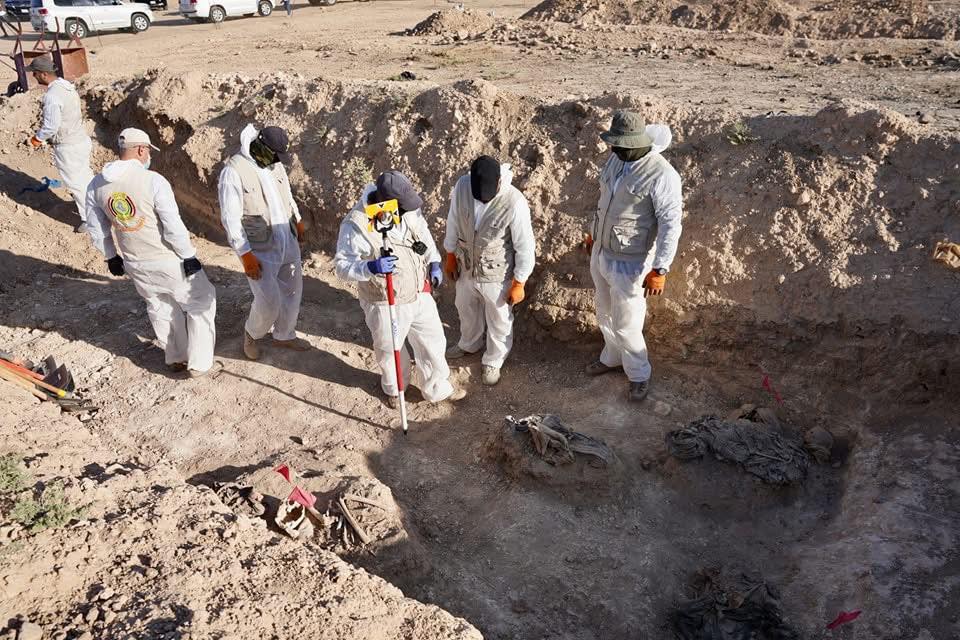
The UN Investigative Team to Promote Accountability for Crimes Committed by Da'esh (UNITAD) operated in Iraq from 2018 to 2024, collecting evidence of ISIS crimes for use in prosecutions worldwide. Its work was significant: 68 mass grave sites excavated, extensive documentation of genocide, war crimes, and crimes against humanity.
But UNITAD was an investigative body, not a prosecutorial one. It collected evidence. It did not prosecute. And when Iraq's government declined to renew its mandate in 2024, the evidence it had gathered remained in Iraqi custody — in a judicial system that the international community has repeatedly criticized for due process failures and mass trials that prioritize processing speed over establishing truth.
With UNITAD gone, there is no independent international mechanism monitoring what happens to that evidence, or to the prosecutions built on it.
Structural Impunity
Iraq's transitional justice failures are not primarily failures of law. They are failures of political will in a system structured around impunity.
State-affiliated armed groups — the Popular Mobilization Forces and their affiliated militias — have committed documented human rights abuses both during and after the fight against ISIS. Some of those abuses were committed against the same minority communities that ISIS targeted. Almost none have faced accountability.
In this environment, transitional justice mechanisms become performance rather than process — ways of demonstrating to international observers that Iraq takes accountability seriously, without actually delivering the consequences that accountability requires.
What Genuine Transitional Justice Would Require
- Prosecutions that prioritize the most serious crimes and the most responsible perpetrators
- Reparations that actually reach survivors — not compensation laws that most applicants cannot access
- Truth-seeking that involves survivors in establishing what happened
- Institutional reform that addresses militia impunity and judicial dependence
- Guarantees of non-recurrence — structural changes that make a repeat less likely
Conclusion
Transitional justice in Iraq is neither pure illusion nor genuine reality. It is something more frustrating: a real framework producing inadequate outcomes, perpetually described as a work in progress by those responsible for its implementation.
For survivors who have waited a decade for accountability — who gave testimony to UNITAD investigators, who applied for compensation under the Yazidi Survivors Law, who buried family members in unmarked graves — the distinction between a justice process that is slow and one that has failed is becoming impossible to maintain.
Iraq has the laws. It has the evidence. It has the international support. What it consistently lacks is the political will to deliver consequences to the people who committed the worst crimes — when those people are connected to the system that would have to prosecute them.
That is not a technical problem. It is a political one.
Independent Research & Analysis
Hussein Monitor
Hussein Monitor publishes in-depth field research on Iraqi minority rights, post-ISIS accountability, and the human cost of impunity. By Hussein Zainulabdeen — former UNAMI Liaison Officer and independent researcher.
Comments
Post a Comment